



This new four-part series—Programming Mastery—is designed to help you build a simple, repeatable, school-specific programming system you can rely on all year long.
Most coaches don’t have a programming problem.
They have a systems problem.
And almost every systems problem starts in the same place:
Programming for your preferences instead of your athletes’ needs.
Needs Analysis is the foundation that makes everything else work.
It sets the standard for exercise selection, weekly design, and long-term progress.
Today, we’re starting where great programming actually begins—understanding your athletes, your environment, and your constraints.

Why Needs Analysis Matters
You can’t build an effective program until you understand who you’re building it for.
High school Strength & Speed is the most variable training environment in the entire profession.
On any given day, you might have:
freshman who have never lifted
seniors with four years of training
a D1 recruit
multi-sport athletes in-season all the time
school & club athletes stacking two practices after school
non-athletes in the same class as varsity starters
students who need confidence
students who need guardrails
students who need autonomy
College systems don’t plug-and-play here.
Social media programs don’t plug-and-play here.
Your personal training preferences don’t plug-and-play here.
Needs Analysis gives you clarity.
It helps you identify what matters, what doesn’t, and what your setting actually requires.
Without it, programming becomes emotional, random, and inconsistent.
With it, programming becomes repeatable, teachable, and sustainable.
The Big 6 Variables in High School Needs Analysis
Build your program around your athletes, not your preferences.
These are the six areas that shape everything you build.
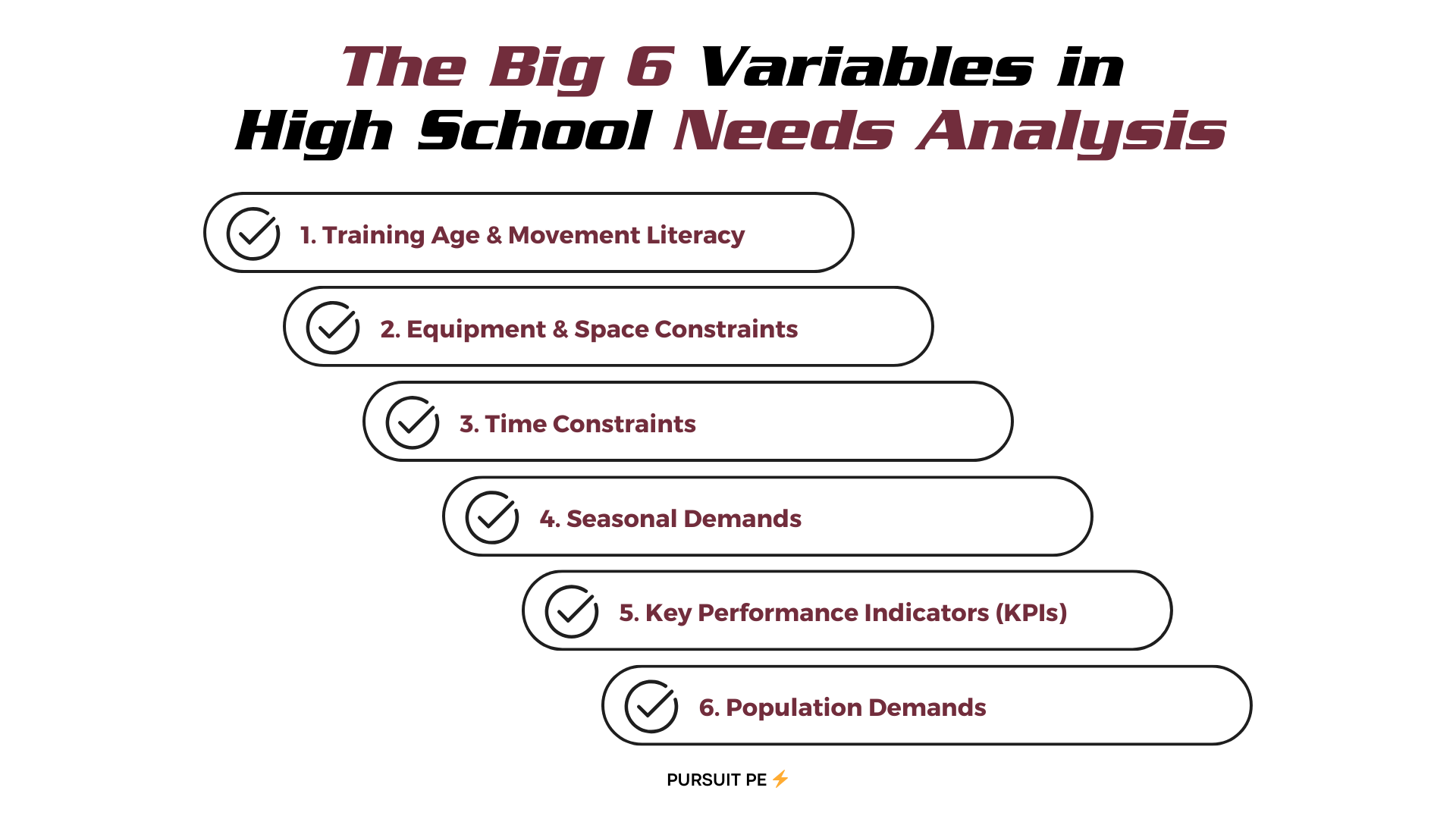
1. Training Age & Movement Literacy
Before you think percentages, progressions, or split structures, you need to know this:
What can your kids actually do?
Can they hinge?
Can they squat without pain or collapse?
Can they land?
Can they sprint upright?
Can they brace?
Can they follow coaching cues?
You can’t out-program poor mechanics.
You can only teach them, repeat them, and reinforce them.
Training age drives:
exercise selection
load choices
your weekly rhythm
how you coach progression
the pace of your teaching
It is the single most important variable in the high school setting.
2. Equipment & Space Constraints
Your room is your reality.
Your system must fit your room—not the other way around.
Questions to ask:
How many racks?
How many bars?
How many plates?
How many kids per class?
Can you use hallways, gyms, or classrooms?
Can you teach on the move?
How fast does your room transition?
Space and equipment don’t limit great programming—they reveal it. I often say that constraints build creativity. Constraints aren’t bad, you just have to be aware of them.
3. Time Constraints
If you teach Strength & Speed inside the school day, this one matters more than anything else.
42-minute periods
85-minute block days
Early bird
Shortened schedules
Assemblies
Late starts
You must build a system that works regardless of the bell schedule.
Time constraints determine:
session flow
movement choices
volume
intensity
how much autonomy you can give
how much teaching you can do
When time is tight, simplicity wins.
4. Seasonal Demands
A volleyball athlete in October is living a very different reality than a baseball athlete in February.
But here’s the key:
Your program shouldn’t change every time the season does.
We keep the same structure, and adjust volume using the stoplight system:
Green Days: Full training dose
Yellow Days: Controlled volume
Red Days: Low volume, high intent
This keeps athletes progressing without fighting their sport demands.
In-season athletes need smart, intentional training — not overload.
Off-season athletes need consistency — not constant novelty.
Seasonal demands shift daily / weekly.
Your system should be built to handle that.
5. Key Performance Indicators (KPIs)
You don’t need 20 data points.
A small set of KPIs will tell you everything you need to know:
sprint times
jumps
a squat or split-squat variation
an upper-body strength marker
KPIs eliminate guesswork. They show you what’s improving, what’s not, and whether your system is actually producing what it claims to.
Without clear KPIs, you’re programming in the dark.
6. Population Demands
This is where high school programming becomes real.
You might have:
35+ students in the room
only eight are varsity athletes
ten have very little training experience
several are dealing with stress or low confidence
multiple athletes balancing multiple sports
a mix of personalities and responsibilities
Your system must be able to scale without falling apart.
This is why Needs Analysis exists.

A Simple, School-Specific Needs Analysis You Can Do Today
You don’t need a spreadsheet.
You need clarity.
Do these four things:
1. List Your Real Constraints
Time, space, equipment, class size, seasons.
2. Identify Your Athlete Population
Movement readiness, experience, in-season demands.
3. Choose Three Non-Negotiables
What must your program deliver every single day?
Examples:
movement quality
sprint exposure
simple, sustainable volume
consistency across classes
4. Cut the Fluff
If it doesn’t serve your population or non-negotiables, it doesn’t belong.
Great programming is not about doing more.
It’s about doing the right things consistently.
Common Mistakes in Needs Analysis
Copying college programs
Programming for the top 5% instead of the entire class
Making sessions too complex
Ignoring class periods and school rhythms
Prioritizing personal preference over student need
Changing programming based on energy or emotion
A quality Needs Analysis eliminates all of this.
Interested in advancing your coaching career? Check out the 12-month online UWRF Strength & Conditioning Master’s Program — flexible format, no GRE, and they cover your CSCS exam. Learn more HERE.
Why This Matters for the Entire Series
Once you understand your needs clearly:
Exercise selection becomes obvious
Weekly planning becomes predictable
Progressions are easier to teach
Assistants and student leaders can support your system
Long-term athletic development becomes sustainable
Culture becomes more consistent
Needs Analysis is the foundation.
Everything else builds from here.
Programs built on preference fall apart.
Programs built on needs last.
Do the work upfront—your athletes will feel it all year long.
Next Up
Programming Mastery #2 — Exercise Selection: Choosing Movements That Transfer
We’ll break down how to build an exercise bank that is simple, scalable, and sustainable inside the school day.
Need Help Building Your System?
If you’re looking to build or refine a Strength & Speed program that fits inside the school day, I can help.
Pursuit PE Consulting offers both on-site and virtual support to help schools build systems that last—structured, sustainable, and culture-driven.
“Average coaches have quotes.
Good coaches have a plan.
Elite coaches have a system.”
- Tim Kight
Let’s build yours.
Reply to this email or message me directly.
Keep pursuing excellence,
Preston ⚡️
This Week’s Paid Subscriber Resource
Upgrade your subscription to Pursuit PE to unlock these tools ⤵
Paid subscribers can access:
Programming Starter Pack – Part 1: Needs Analysis Toolkit
Needs Analysis Checklist
Program Constraint Mapping Sheet
Not a paid subscriber yet? Upgrade today to unlock this and all upcoming resources.
